

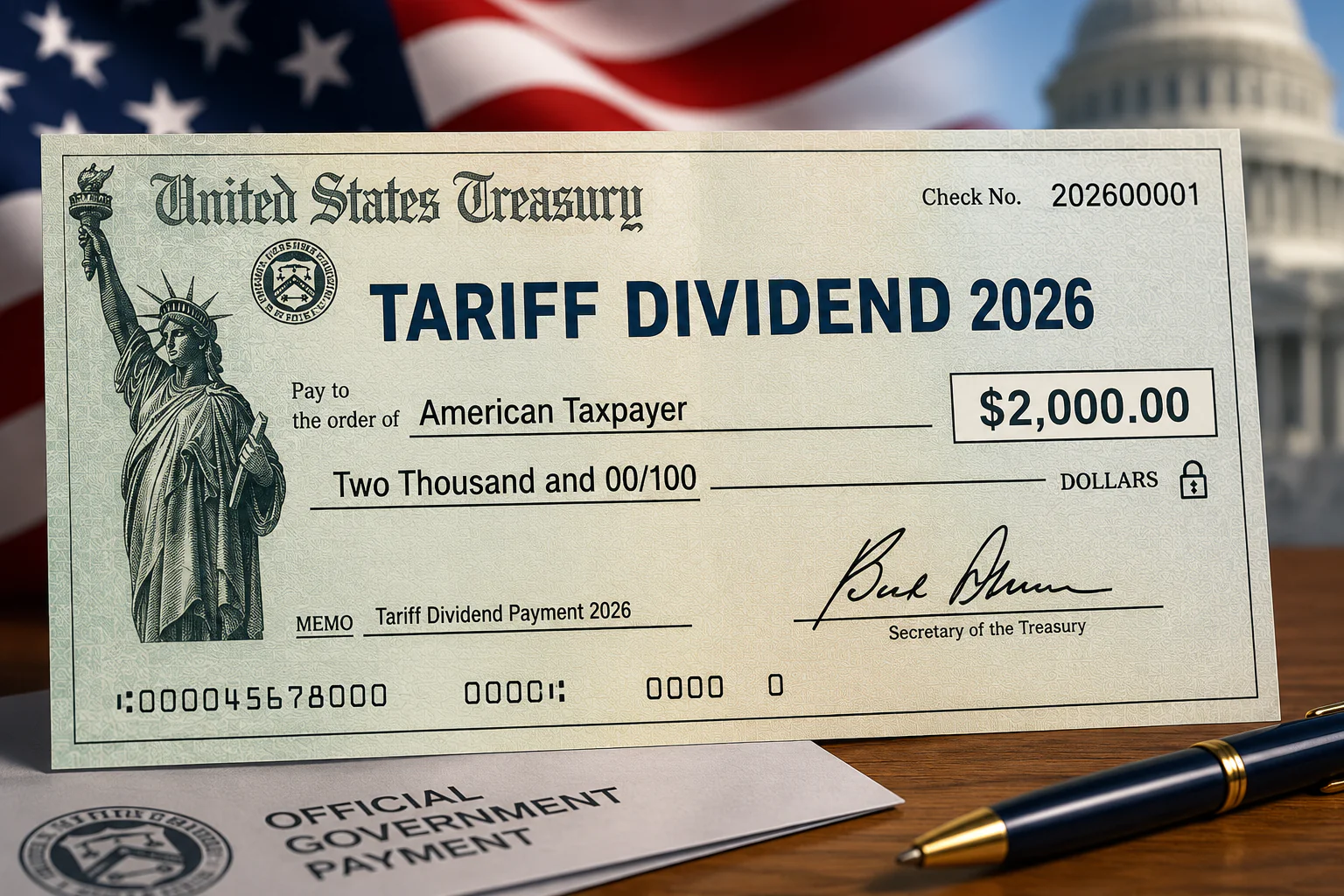
Millions of Americans have been waiting for months in the hope of a reality that has floated in the political ether: a $2,000 tariff-dividend check, paid for by the trillions of dollars the federal government collects from tariffs. It seems simple: tariffs collect money, and a part of it is returned to you. However, in 2026, the actual situation is much more complicated than the headline suggests, and a sequence of legal, legislative,e and economic developments has put this plan in serious doubt.
The most complete and current book available on the tariff dividend check — what was guaranteed, what has happened, where we are today after a historic Supreme Court decision, and what to expect.
Table of Contents
The Promise: Where Did the $2,000 Figure Come From?
It was included in the mainstream conversation in November 2025 when President Donald Trump shared on his Truth Social platform: “A dividend of at least $2,000 a person (excluding high-income individuals!) will be given to everyone. A few days later, he elaborated on that at the White House, telling reporters on Air Force One that the tariffs the U.S. levies do provide a payout, and that the administration also intended to pay some of the revenue to the national debt.
It was a political ploy. Throughout 2025, Trump had been combating critics who were concerned that the costs of his broad “Liberation Day” tariff policy were being borne by ordinary consumers, rather than foreign governments. The double benefit of a direct dividend payment to American households was that it would confirm the tariff gambit as a good thing for working families, and it would arrive right before the midterm elections in 2026.
“Next year is going to be the biggest tax refund season ever, and we’re going to be giving back refunds out of the tariffs,” Trump said at a meeting of his cabinet on Dec. 2, 2025. “We’re going to be giving a nice dividend to the people in addition to reducing debt.” On November 17, he explained that just the “individuals of moderate income” were to receive the dividend and confirmed that it would be possible thanks to tariff revenues.
The concept is akin to Alaska’s Permanent Fund Dividend, which pays annual dividends from oil revenues. TARF would be analogous to the flow of tariff revenue back to consumers, who would essentially pay the tariff in the form of higher prices. But, as quickly as experts noted, the analogy will not hold up to the test — nor should it.
Why Congress — Not Trump — Holds the Keys
Even though the populist rhetoric, the tariff dividend is not something that the executive branch can simply decree. This is an important distinction that the majority of headlines have neglected to note. On December 21, 2025, on CBS News’ “Face the Nation” program, White House National Economic Council director Kevin Hassett was crystal clear: The dividend checks would have to be passed by Congress before they could be distributed.
“So we collect taxes, we collect tariffs, we collect revenue from lots of places, and then Congress decides what to do with the money,” Hassett told CBS News. “That’s an appropriation, and this would have to be approved by Congress.” He said he was now hopeful about the deficit numbers as they came in ahead of expectations and that the president would put forward a formal proposal to Congress in early 2026.
So far (mid-2026), that proposal has not become legislation. There has been no passage in either house of the legislature of a bill establishing a tariff dividend. Treasury has not established the necessary systems and procedures to implement such payments. There is no fixed date for the mailing. In March 2026, another legislative bill was also introduced by Senator Martin Heinrich (D-N.M.) and has also been stuck in committee that would establish a $1,200 tax rebate for joint filers who make less than $180,000, with $600 added per dependent child.
Comparing stimulus checks to the COVID stimulus bill is instructive, but not apt. Those checks needed legislation (the CARES Act), emergency appropriations, an active IRS system, and bipartisan political support. The same machine should be needed for a tariff dividend check. In a fractious political climate in which Congress is also struggling to deal with the debt ceiling and the midpoint, and a changing trade policy environment, that machine has been sluggish to get moving.

The Supreme Court Decision That Changed Everything
The Supreme Court’s decision on February 20, 2026, was the turning point in the entire tariff dividend discussion. The Court ruled in favor of Learning Resources, Inc. in a 6-3 decision with Chief Justice John Roberts in the majority opinion that the International Emergency Economic Powers Act (IEEPA) does not give the president authority to impose tariffs.
The ruling struck down the “Liberation Day” reciprocal tariffs, the Canadian, Mexican, and Chinese tariffs on fentanyl imports, and any other tariff action based on the IEEPA that had been at the heart of the administration’s trade policies since 2025. All the IEEPA tariffs were eliminated by 24 February 2026, and the Budget Lab at Yale estimates that the tariffs that were already collected would have amounted to approximately $166 billion.
The ruling immediately and in a complex way affected the tariff dividend math. Trump was referring to the revenue base as a source of funding for the dividend, but that revenue base was significantly reduced. The administration has invoked a lesser-known authority, Section 122 of the Trade Act of 1974, that lets the president impose tariffs for up to 150 days, beginning at 10% and increasing to 15%. At the time, Treasury Secretary Scott Bessent said this change “will cause the tariff revenues to remain essentially the same in 2026,” but independent analysts doubted this.
Most important of all, the IEEPA decision kick-started a massive, continuous legal process on refunds to importers, businesses that had paid billions of dollars in now illegal duties. In early March 2026, the Court of International Trade ruled CBP should start processing refunds for the nearly 2,000 importers who challenged the rule in court. This is an independent and genuine refund process, but it is not to the consumer; it’s to the business. The IEEPA importer refunds are not $2,000 tariff dividend checks — it’s a fact!
For an in-depth look at how tariff trade policy affects businesses and broader economic conditions, explore our latest business news at adityasinghtharran.com.
What the Yale Budget Lab Found
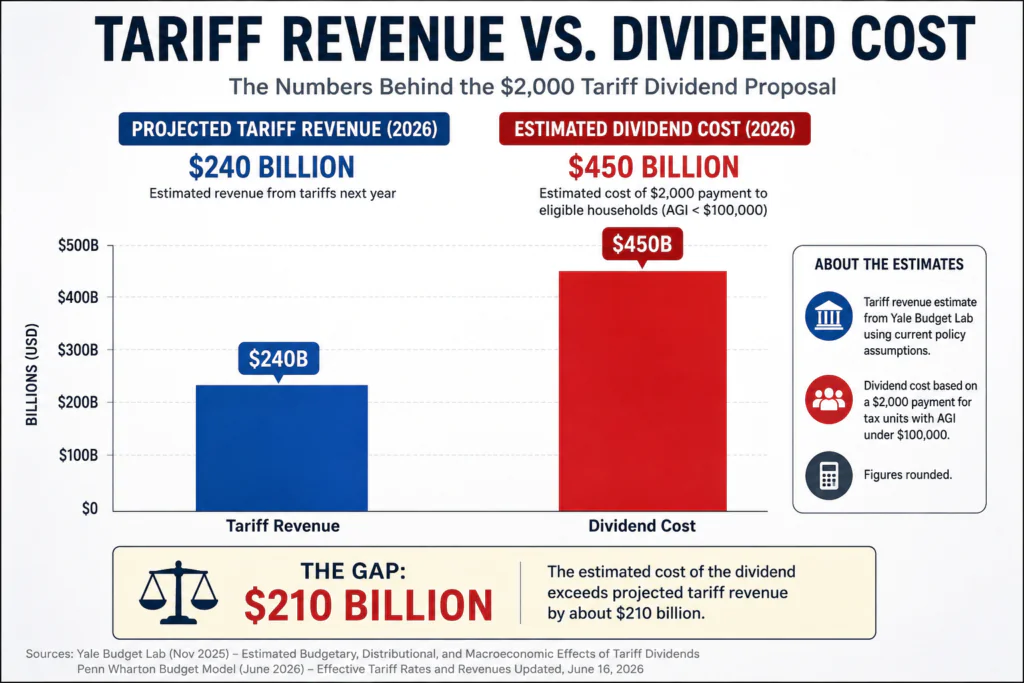
The Yale University Budget Lab has conducted the most independent study of the tariff dividend proposal, and it is not reassuring. The Lab found that a $2,000 per-person rebate, capped at $100,000 annually, would cost around $450 billion. This is about twice the amount of revenue the administration expects to generate in 2026 from its tariff increases.
Let that sink in. The price tag charged to deliver the promised check is twice the revenues that are supposed to be used for it. This is not a mere bookkeeping error, but a structural impossibility with no additional borrowing or new revenue sources. In other words, the government could be paying $2,000 to every qualifying American from the tariff, using just about $900 billion in tariff revenue in a single year, but that is not the volume of tariff revenue that is collected now.
The Yale Lab did find some positive economic effects of the dividend plan: GDP would experience a modest increase in 2026 (0.3 percent), as would employment (0.15 percent) if the checks were distributed. However, the Lab cautioned that this short-term surge would decline in the next few years and that there would be little to no gains in long-run output. But the Lab’s results were more comforting on inflation: “The direct effect of sending them checks will be muted, meaning that payments will not greatly exacerbate the inflation situation.
The new Section 122 tariffs now in place impose a cost burden on the household. If these tariffs are extended beyond the 150 days, the average American family will lose about $1,130 in purchasing power because of the tariffs, according to the Yale Lab’s estimates. The figure is reduced to approximately $648 per household if the tariffs are due to expire on time. In either case, that tax hike is real, tangible, and accumulating on the consumer, and the dividend is still theoretical.
Tariff Revenue vs. Dividend Cost: The Real Math
Key Numbers at a Glance
Metric | Figure | Source |
Projected cost of $2,000/person dividend (income < $100K) | ~$450 billion | Yale Budget Lab |
Total tariff revenue projected for 2026 | ~$225 billion | Yale Budget Lab |
IEEPA tariff duties already collected (pre-ruling) | ~$166 billion | U.S. CBP data |
Average household price burden (Section 122 extended) | ~$1,130/year | Yale Budget Lab |
Average household price burden (Section 122 expires) | ~$648/year | Yale Budget Lab |
U.S. effective tariff rate as of April 2026 | 11.0% | Yale Budget Lab |
Joint Economic Committee household tariff cost estimate | >$2,500 for 2026 | U.S. Congress JEC |
Section 122 tariff expiry date (scheduled) | ~July 24, 2026 | Trade Act of 1974 |
The problem at the heart of the matter is revenue minus cost. The Tax Foundation has calculated that Trump’s tariffs will cost about $2.1 trillion over 10 years, which is a lot, but stretched out over 10 years. It’s mathematically impossible to dedicate even a portion of that for one year to hundreds of millions of Americans without borrowing, cuts to other programs, or a significant change to the $2,000 amount.
Bankrate analyst Mark Hamrick described the situation perfectly when he told CNBC that “direct payments could paradoxically make inflation worse — adding hundreds of billions to the economy when supply chains are also strained by tariff-induced price hikes would present a classic inflationary scenario. The checks would help increase demand just as supply is limited, which helped drive up inflation in 2021 – 2022 following the pandemic.
Who Would Qualify for a Tariff Dividend Check?
From Trump’s comments and the outline that White House advisors hope to discuss, the requirements would be:
Income threshold: those who make less than about $100,000 annually. The same income phase-outs would apply to high earners, similar to how they’ve been applied to COVID stimulus payments.
Payments would be made only to U.S. citizens or residents, just as with stimulus checks in 2020 and 2021.
Family of four: The $2,000 amount seems to be designed on a per-person basis, so the family of four would potentially receive $8,000, although it’s not yet confirmed in any stimulus bill.
No additional dependent amount specified: The White House-drafted version has not been clear on any extra amounts for dependents, while Senator Heinrich’s alternative proposal (which would add $600 per child) did.
On an interesting note, none of this is binding law. These criteria are not legislative, but are based on public statements and adviser comments. Congress may end up with a totally different bill at the end of the day.
Tariff Dividend vs. COVID Stimulus: A Comparison
Feature | COVID Stimulus (CARES Act, 2020) | Proposed Tariff Dividend (2026) |
Legislation passed | Yes (CARES Act, March 2020) | No |
Payment per person | Up to $1,200 | Up to $2,000 (proposed) |
Income limit | $75,000 (individual) | ~$100,000 (proposed) |
Funded by | Emergency borrowing | Tariff revenue (proposed) |
IRS distribution ready | Yes | No |
Timeline from passage to payment | ~3 weeks | Unknown |
Congressional approval needed | Yes | Yes |
Status | Completed | Not enacted |
The Timeline: When Could Checks Actually Arrive?
The time frame has been delayed several times. Trump initially proposed the middle of 2026 as a goal. In a subsequent interview in the New York Times, it took a U-turn and upbeat change in the sentence to “later in 2026,” but no date. With the legislation still to go — draft a bill, get it through both houses of Congress, get it signed by the President, put the distribution system in place, and process payments — any check that arrives in calendar year 2026 will take an extraordinary burst of speed from a Congress which has yet to present a formal White House proposal.
This tariff authority is another complicating factor; it expires around July 24, 2026. Otherwise, the tariff revenue base is cut back again, exacerbating the fiscal arithmetic. But if the administration wants a Section 122 extension, then that legislative debate will take up congressional time that could be devoted to a bill to increase the nation’s debt.
The midterm election calendar is also important. Members of Congress up for re-election this November will have both strong incentives to pass a check before the November election, and enough time in order to process the check before the election, or to simply ignore the check without ever having to vote on it. But experience indicates that the latter is much more likely in the case of costly, complex, legalistic offers, where there is no funding plan.
Scam Warning: Fake Tariff Dividend Emails
As awareness of the tariff dividend proposal has grown, scammers have moved in. If you receive an email, text message, or social media post claiming you have been approved for a tariff dividend check — especially if it asks for your Social Security number, bank account details, or an upfront fee to “process” your payment — it is a scam. No government agency is currently distributing tariff dividend checks. No application process exists. No official enrollment portal has been created.
The Federal Trade Commission’s standard guidance applies here: the government will never ask you to pay a fee to receive a government payment, will never ask for your bank account information via email, and will never contact you through unofficial channels. If you suspect you have encountered a tariff dividend scam, report it at ftc.gov/complaint.
For additional context on how to spot fraudulent government payment schemes, read more from our knowledge centre at adityasinghtharran.com.
Expert Opinions and Economist Reactions
The economics profession has been notably skeptical — and in some cases, openly critical — of the tariff dividend proposal.
Tomas Philipson, professor of public policy studies at the University of Chicago and former acting chair of the White House Council of Economic Advisers, offered a cautiously framed endorsement of tariff policy while noting the dividend logic was strained: “The White House may decide to issue so-called tariff dividend checks in 2026, but they won’t be fully financed by U.S. tariffs, and they won’t be dividends since Americans paid these tariffs in the first place.” He added pointedly: “It’s not a dividend when you give money back to people that they paid earlier.”
That critique cuts to the core of the marketing problem. A “dividend” implies profits being distributed — money earned above and beyond costs. But tariff revenue, by most economists’ assessments, is effectively a consumption tax on American importers and, through them, on American consumers. Returning some of that money does not create new wealth; it partially reverses a burden that never should have been framed as a windfall.
Bankrate’s chief financial analyst has described the probability of checks being issued as near zero, citing the gap between revenue projections and cost estimates. Meanwhile, the Joint Economic Committee’s minority staff — drawing on independent data — estimated that tariffs could cost each American household more than $2,500 in 2026 through higher prices, meaning even a fully delivered $2,000 check would leave most households net negative on the tariff math.
For deeper analysis of economic policy trends and their household impact, check our technology and economics coverage at adityasinghtharran.com.
Should You Plan Your Budget Around This Check?
The honest answer is no. A $2,000 tariff dividend check is a proposal without legislation, a promise without a payment mechanism, and a concept whose fiscal math does not add up under independent scrutiny. That does not mean it can never happen — political will and creative budget maneuvering have produced surprising outcomes before. But making financial decisions based on money that has not been authorized, appropriated, or scheduled for distribution is a significant risk.
A poll conducted in late 2025 found that only 37% of Americans believed the government would actually issue the checks to most people, while 55% called it unlikely. Among Republicans, 52% expressed optimism; among Democrats, only 21%. Those skepticism levels are arguably well-calibrated to the facts on the ground.
What you can do right now is ensure your tax situation is current, review your withholding, and pay attention to any legitimate congressional developments around tariff relief. If a bill does eventually pass — and that remains a genuine possibility ahead of the midterms — the actual eligibility criteria and payment amounts may differ substantially from what has been discussed publicly. Stay informed through trusted sources, and treat any unsolicited communication about a tariff check with extreme caution.
Conclusion
The $2,000 tariff dividend check is one of the most widely discussed and least understood economic proposals of 2026. Trump’s original promise generated enormous public interest and political momentum. But the Supreme Court’s February 2026 ruling gutted the IEEPA tariff authority that was central to the funding story. Congress has yet to pass enabling legislation, and independent analysts have consistently found that the cost of the proposal dwarfs the revenue available to fund it.
None of this means the check will never arrive. Political dynamics, especially in a midterm year, can move fast. But as of mid-2026, the tariff dividend check exists as a proposal, not a policy — and Americans who plan their finances accordingly will be better served than those who bank on a check that has not yet cleared any legal or legislative hurdle.
For ongoing coverage of economic policy, government payments, and financial news, explore our latest articles at adityasinghtharran.com.
FAQ Schema: Tariff Dividend Check 2026
Is the $2,000 tariff dividend check real?
The proposal is real — President Trump publicly announced it on Truth Social in November 2025 and has discussed it repeatedly. However, no legislation has been passed, no payment infrastructure has been built, and no official eligibility list or application exists. It remains a proposal, not an enacted policy.
Has Congress approved the tariff dividend check?
No, As of mid-2026, Congress has not passed any legislation authorizing tariff dividend checks. White House adviser Kevin Hassett confirmed in December 2025 that congressional approval would be required before payments could be distributed.
Who would qualify for the tariff dividend check?
Based on Trump’s public statements, the check would be available to individuals earning less than approximately $100,000 per year. High-income earners would be excluded. However, no final eligibility criteria exist because no bill has been enacted.
How much would the tariff dividend cost the government?
The Yale Budget Lab estimates that a one-time $2,000 per-person rebate with a $100,000 income limit would cost approximately $450 billion — roughly twice the total tariff revenue projected for 2026.
What did the Supreme Court ruling mean for the tariff dividend?
The Supreme Court’s February 20, 2026, ruling in Learning Resources, Inc. v. Trump struck down all IEEPA-based tariffs, which were the primary source of tariff revenue cited as the funding mechanism for the dividend. The administration moved to Section 122 authority for new tariffs, but revenue projections are lower, and the legal authority expires in approximately 150 days.
When would the tariff dividend checks be sent out?
Originally discussed for mid-2026, the timeline was pushed to “later in 2026” in a subsequent interview with the New York Times. Given the legislative steps still required, no specific date is confirmed or realistic in the near term.
Is there a tariff dividend check scam I should know about?
Yes, Scammers are sending emails and texts claiming recipients have been approved for a tariff dividend check. No such approval process exists. The government will never ask for an upfront fee or personal banking details via email to process a government payment. Report suspected scams at ftc.gov/complaint.
Are the IEEPA importer refunds the same as the $2,000 dividend check?
No, The IEEPA refunds following the Supreme Court ruling flow to importers — businesses that paid tariffs on goods they brought into the United States. The proposed $2,000 tariff dividend check would go to individual consumers. These are entirely separate mechanisms.
Could the tariff dividend check still happen before the 2026 midterms?
It is theoretically possible but increasingly unlikely. Congress would need to draft, debate, pass, and sign legislation, after which the IRS or Treasury would need weeks to build and execute a distribution system. Given the congressional calendar and current legislative priorities, a pre-midterm payment would require action by September 2026.
Should I adjust my budget in anticipation of receiving a tariff dividend check?
Financial advisers generally recommend against planning around money that has not been authorized by law. A 2025 poll found 55% of Americans considered receiving such a check unlikely. Build your budget on confirmed income and monitor official government and news sources for any legislative developments.
Outbound Reference Recommendations
Author Summary
Aditya Singh Tharran is a digital publisher, SEO strategist, and content analyst covering economic policy, government finance, and technology at adityasinghtharran.com. His work focuses on making complex policy developments accessible to everyday readers through rigorous research, authoritative sourcing, and clear, factual analysis.